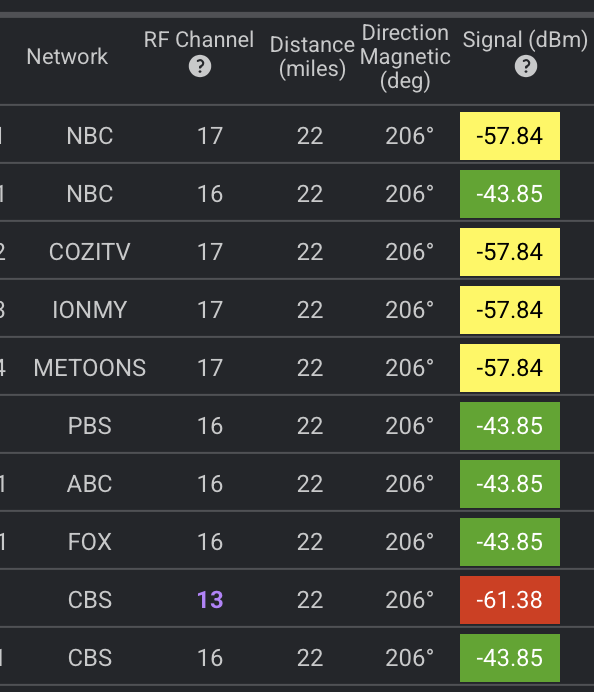
Great idea - I tried it in Grok - (can’t post the link because I’m new)
Really it’s just confirming I need something high, outdoor and preferably with a rotator for the best chance. This may be a bridge too far to attempt. It’s also no guarantee I’ll even get things like Dodgers and the 49ers as I discovered they were airing the AZ team (whatever it’s called, haha) locally on Fox yesterday while most everyone else in the US saw the Niners winning again - now 5-0!
Grok says:
An outdoor (or high attic) multi-directional or directional antenna with good High-VHF + UHF coverage, ideally with a moderate-gain preamp that has automatic gain control (AGC) or can be switched off, is required for reliable reception of all the listed stations. Indoor antennas will not consistently pull in the “Poor” and especially “Bad” ones.
Why this setup is needed
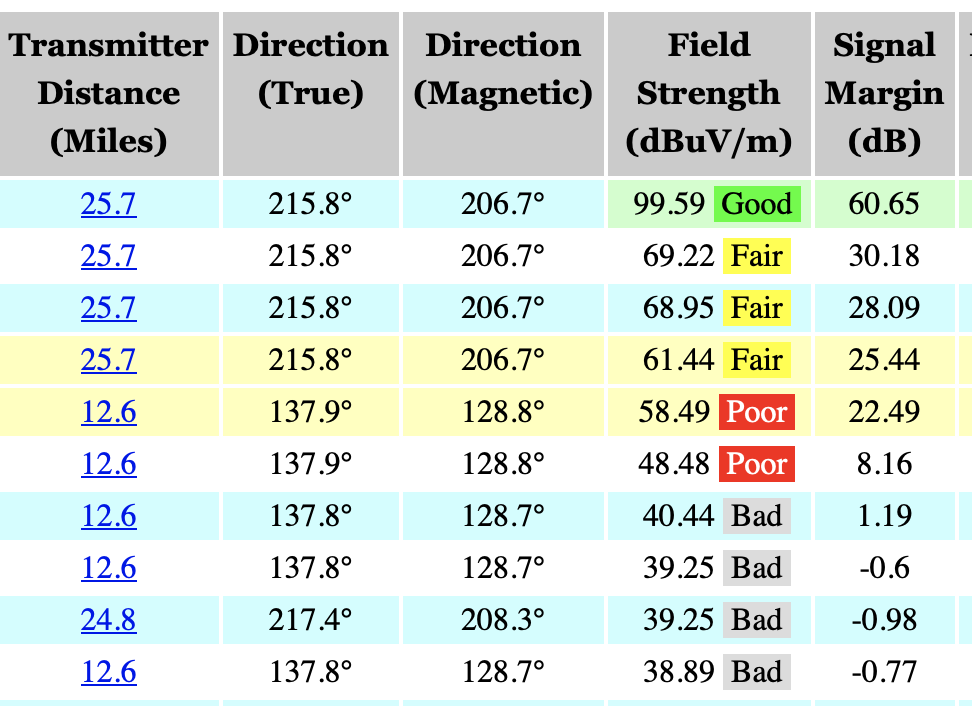
The table (from a RabbitEars-style report) shows a mix of signal qualities at roughly 12–26 miles:
- Good (e.g., KHRR/Telemundo): ~99.6 dBµV/m field strength, ~61 dB signal margin — easy even indoors.
- Fair (several stations): ~61–69 dBµV/m, ~25–30 dB margin — attic or outdoor preferred.
- Poor (KGUN ABC, KUAT PBS): ~48–58 dBµV/m, ~8–22 dB margin — solid outdoor antenna needed.
- Bad (KTTU, KMSB FOX, KPCE, KVOA NBC): ~39 dBµV/m or lower, margins near 0 or negative — these sit at or below the typical noise-limited threshold for reliable digital lock without antenna gain, height, and (often) a low-noise preamp.
FCC planning factors use roughly 36 dBµV/m (High-VHF) and ~41 dBµV/m (UHF) as minimum outdoor service levels at 30 ft; the “Bad” stations are near or below this at the receive location after accounting for real-world losses. Signal margin of 0 dB is roughly a 50/50 chance with a basic outdoor antenna; negative margins require extra gain or better placement.
Directions are split into two main clusters (~138° magnetic / ~12–13 miles and ~207–208° / ~25 miles). A pure unidirectional high-gain Yagi aimed one way will miss or weaken the other cluster. An omnidirectional or multi-directional design (or a directional + rotator / dual antennas) is better.
Frequency bands: Stations use High-VHF (real channels 7–13, e.g., KOLD-13, KGUN-9) and UHF (most others). Low-VHF (2–6) is limited or absent in the list (KUAT is virtual 6 but real channel 30 UHF). Many cheap “flat” or “HDTV” indoor antennas are weak or nonexistent on VHF—choose one rated for both High-VHF and UHF.
Recommended antenna types and example models
Prioritize:
- Outdoor or attic mounting as high as practical with clear(er) line-of-sight toward the mountains (common Tucson transmitter sites include Mount Bigelow).
- High-VHF + UHF elements.
- Moderate gain + AGC/preamp that won’t overload on the very strong local signals.
- Avoid pure UHF-only panels.
Strong practical choices (commonly recommended for mixed 10–30+ mile suburban/rural fringe with split directions):
- Antennas Direct ClearStream 4MAX / MAX-V / 4V series — Multi-directional, excellent High-VHF + UHF, good for suburban distances with some obstruction; relatively compact and reliable.
- Televes DAT BOSS Mix (or DAT BOSS Mix LR) — High-gain directional with intelligent BOSS/TForce preamp (auto-adjusts gain, strong filtering); excellent for the weaker stations while handling strong ones. Aim toward the weaker cluster or use a rotator.
- Winegard YA-7000, HD7694P, or similar Yagi-style — Solid High-VHF + UHF directional options; pair with a rotator if you want both clusters without compromise.
- Channel Master Masterpiece / Advantage series or equivalent multi-element outdoor antennas — Good mid-range directional performance.
For pure 360° coverage without aiming, an amplified multi-directional outdoor model (e.g., certain Channel Master Omni or similar) can work, but directional designs usually deliver more reliable margins on the “Bad” stations.
Installation notes
- Mount outdoors on a mast/roof or high in an attic. Height helps more than raw advertised “miles.”
- Use quality RG6 coax; keep runs short. A mast-mounted preamp (with AGC) helps overcome cable loss on the weak signals without overdriving the strong ones.
- Aim roughly between the two clusters or use a rotator / dual-antenna combiner if needed.
- Rescan channels after installation and fine-tune position/aiming (even a few feet or degrees can matter with multipath).
- Terrain, trees, buildings, and exact address vary results—run your precise address on RabbitEars.info or the FCC DTV maps for confirmation.
An indoor flat or rabbit-ear antenna may get the strongest few stations but will routinely drop or pixelate the Fair/Poor/Bad group. An outdoor High-VHF/UHF antenna of the types above gives the best chance of locking all of them reliably.