The next couple of days we likely will see some unusual OTA signal anomalies in the lower USA.
Specifically “Tropo” interference on FM, VHF and believe it or not UHF frequencies.
Friday morning it’s quite strong and will probably increase Saturday morning.
In Dallas (of the 132 channels that I get) all but one LPTV station (KLEG 44 RF28) went dark due to their signals being overwhelmed.
KXAS 5 the NBC O&O full power RF24 station got to a signal strength of 34% and Tablo Gen4 indicated two red dots.
Full power KDTN 2 on RF29 went dark.
Full power KFWD 52 on RF9 went dark.
(Went dark: RF9, RF10, RF11, RF12, RF13, RF20, RF29)
So if you rescan in the late evening or early morning it could affect your results.
It can also result in scanning out of market stations like KBTX 3 RF16 in Bryan Texas coming in great hundreds of miles from Dallas.
Or KTAL 6 in Shreveport! RF26
3 Likes
Good example of some of the “challenges” of OTA TV. For some reason FOX was a mess here 3 days ago (I was receiving it but it was unwatchable due to very heavy pixelation). All other channels were fine. FOX had been fine, as well. It magically straightened out about 24hrs later. Likely technical difficulties at the station itself or whatever.
You make a good point that rescanning during such “events” will mess up an otherwise “good” channel scan. Best to wait it out, especially if things were working fine previously. The only reason I would ever rescan is if something in the actual broadcast or my equipment changed (new channels or existing channels on different frequencies or maybe a new antenna or amp, etc).
It’s been a long time since The tropo scipped channels my way. Channels from San Antonio and Austin showed up for a few days years ago.
You can also have… Drum roll…
Yes, we have a weak PBS station here in western VA (Blue Ridge PBS, Lo-VHF Channel 4). Lost it completely this week - maybe this is why?
I don’t have time to right now to read all the links but I am curious IF ATSC 3 channels are more likely not to be affected? In the middle of the country and I never see this stuff, at least I have never noticed channel loss.
Was thinking that maybe the technology of ATSC 3 might avoid this issue for the most point ---- guessing is all!!
ATSC 3.0 is a “better” encoding spec for the digital data ultimately being carried on the same old RF signal. I think “better” mostly means more modern and efficient compression such that more digital data can be crammed on the same RF carrier signal. This is what enables more channels, higher resolution, yada yada.
It is still the same old RF signal that is affected by these types of solar/weather events. However, I keep reading ATSC 3.0 will somehow “improve reception” but it must be because the ATSC 3.0 encoding/decoding is somehow more robust with perhaps better error correction.
I have seen mixed reviews as to whether there is any improvement from those in markets where ATSC 3.0 is in play. There is only one transmitter in my area broadcasting using ATSC 3.0, and I am unable to even lock in to it with my newest Sony TV that has an ATSC 3.0 tuner.
Correct it’s still radio.
My personal observation is that it’s worse as far as reception. Specifically because of the current engineering.
Last spring KEYE (CBS) RF34 in Austin overpowered KSTR in Dallas. The A3 Lighthouse for 4 stations/channels went dark for several hours.
The good news was people could watch a new A1 network/program with local Austin commercials. But the Lighthouse has 2 Spanish (Univision and Unimas) and 2 English stations (NexStar CW and Fox).
More recent observations included a thunderstorm knocking out all A3… as a LPTV retransmitting PBS A3 and the Lighthouse went dark.
None of these facilities have auxiliary transmitters so going back to the regular A1 channel is the only solution.
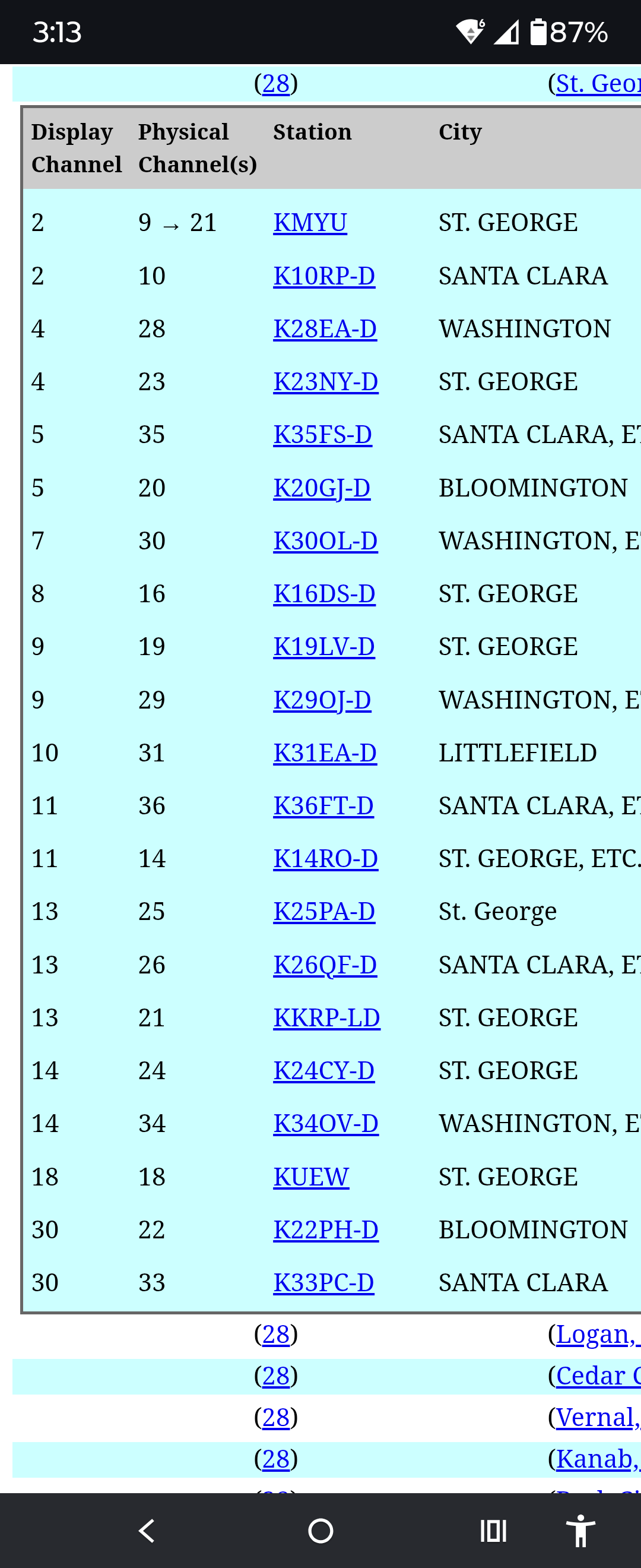
It’s a bit of a mess here in SW Utah, as well. Everything OTA originates from the mothership (SLC), and gets bounced around from mountain top to mountain top all over the state via 100’s of “translators”. Any interference in that complex RF network can wipe out OTA transmissions here in SW Utah.
From my house, I have 2 choices of antenna farms approx 180 degrees apart with exactly the same content on different pairs of RF channels. All very low power. One is 5 miles away with a hill in the way, the other is 14 miles away LOS.
Over the 8 years I’ve lived here I’ve gone through several different antennas, and back and forth on which antenna farm I try to “harvest” from. Constant battle for reliable signals with so many variables in play. What works perfectly for weeks suddenly fails for no obvious reason. Then it’s all fine again the next day. I’ve even called the stations in SLC and been told things like “thanks for letting us know, we will try to get a tech up there in the spring when the snow melts off of that mountain”.
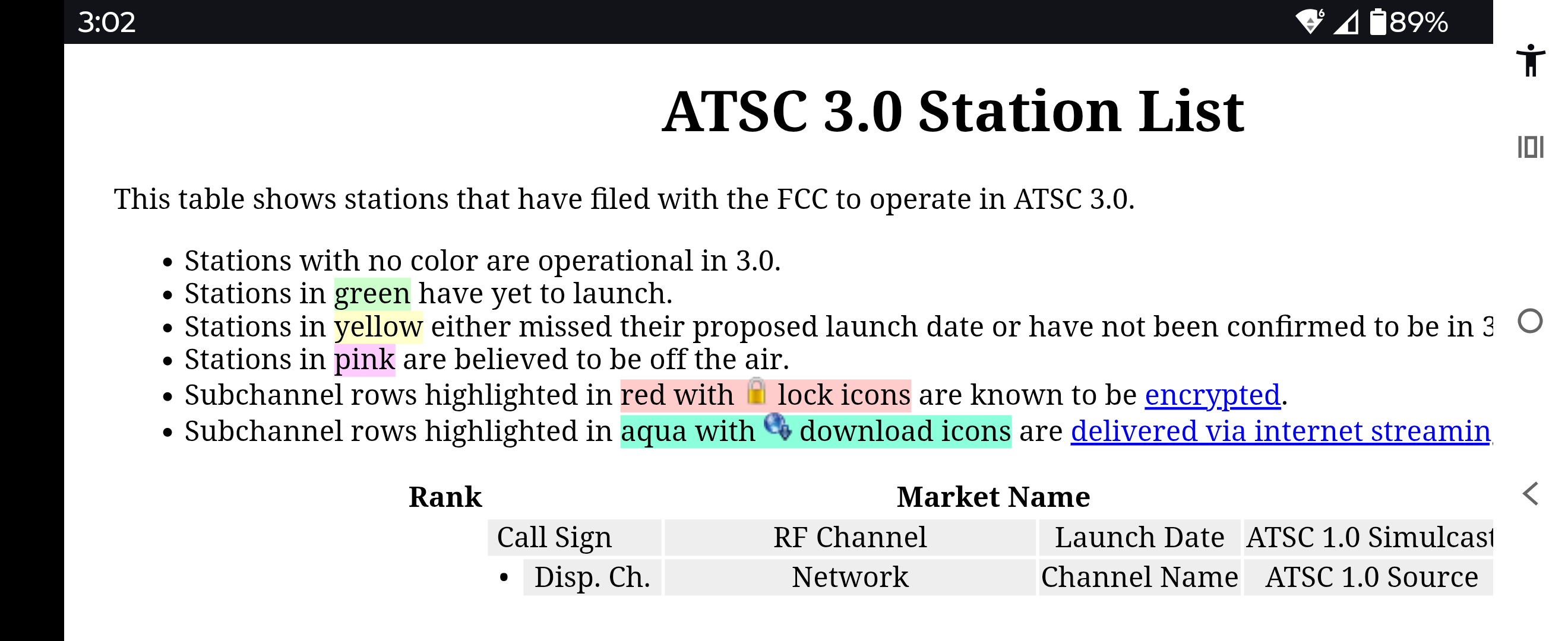
As I mentioned, the single ATSC 3.0 transmitter at each antenna farm is useless. I think these were part of an experiment started in 2022 to try to demo this new tech. Very low power and according to my new Sony, there simply isn’t anything there. Maybe they are not even in service. Who knows.
1 Like
Actually I am in Saint George. However, it all comes from SLC.
These are the 6 transmitters I currently pull from the West Peak antenna farm 14 miles to the west. I only use 1 virtual channel from each:
CBS, ABC, NBC, PBS, FOX, and CW.
Then you are right again. Not even one A3 station.
Given that digital reception is either on or off (unlike analog reception which just keeps deteriorating) any increase in the ATSC3 signal decoding threshold might improve reception when it’s right at the borderline.
1 Like
Oops. Wrong thread
Post Deleted