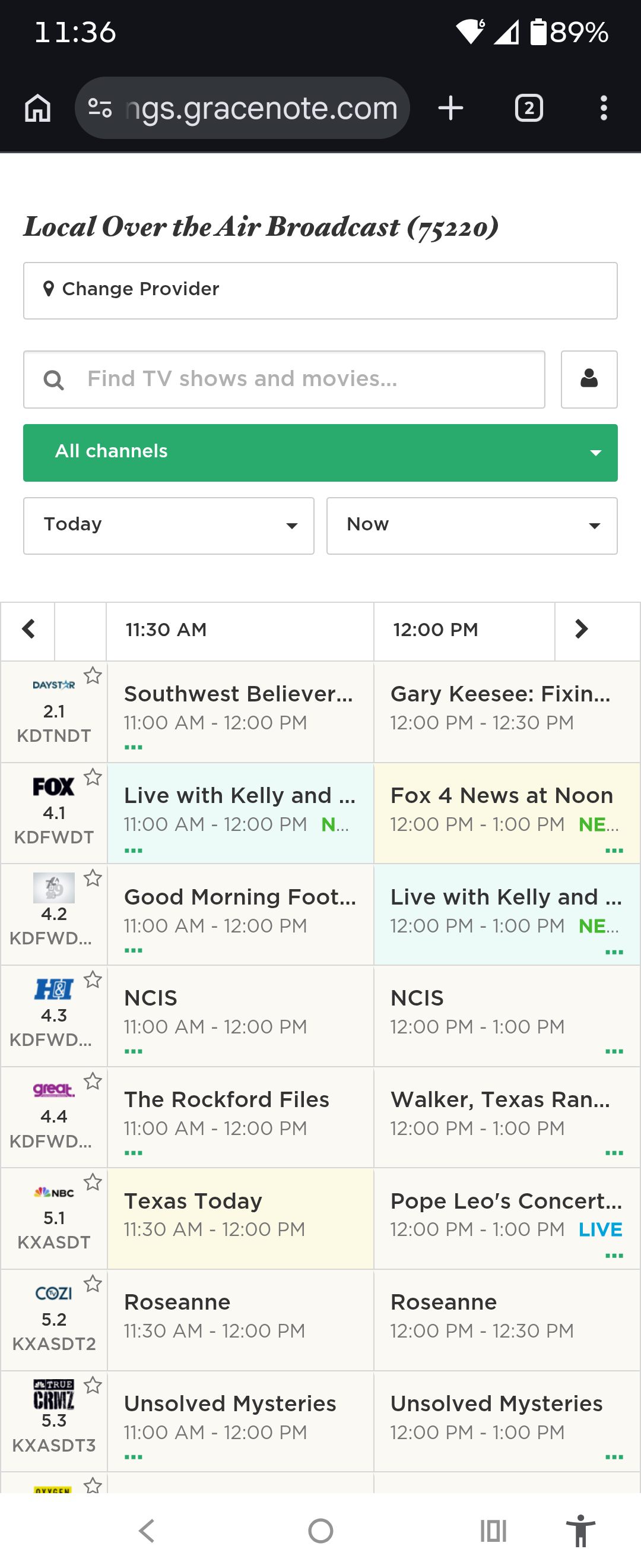
In the Albuquerque local market KRQE 13-1 in no longer a CBS station as of 8/1/26. That channel will be a FOX network station and a CBS station will be assigned at channel 7-4 owned by Hearst communications.
I hope Tablo watches this stuff and corrects the guide in real time so scheduled recordings will continue to happen.
KOAT’s FAQ has a phone number at the bottom. Call them and ask when they are going to update Gracenote’s guide data. Gracenote’s current guide data for channel 7.4 for the first week of August is not CBS.
In Albuquerque, I rescanned channels this morning and 7.4 came up as “TEST”. I added it to my guide. At that time, it was rebroadcasting KOAT’s ABC channel from 7.1.
I failed to mention it but the channel logo is in fact QVC. 7.4 probably is being reassigned from QVC, but I never keep any shopping channels in my live guide, so it probably has been QVC all along.
Right now, 5:24am mountain time, 7.4 is mirroring the 7.1 signal, which is KOAT news, just as it was yesterday. But the logo and guide data remains QVC.
I thought the channel logo was part of the channel scan not the guide data since it’s a field in the broadcast data. And the forum use to be littered with questions on how to get it to self correct.
For those who haven’t read and don’t want to read a/65.
Within the VCT loop, each individual sub-channel is defined using a specific bit-allocation payload structured like this:
Short Name: A 7-character field encoded in 16-bit Unicode (UTF-16) to display the station call sign (e.g., “WNBC-HD”).
Major Channel Number: A 10-bit field defining the primary channel digit.
Minor Channel Number: A 10-bit field defining the sub-channel digit.
Modulation Mode: An 8-bit field indicating how the signal is sent (e.g., 0x04 for ATSC terrestrial 8-VSB, or 0x05 for cable 64-QAM).
Carrier Frequency: A 32-bit field, typically set to zero in terrestrial broadcasts because the physical frequency is managed by the underlying transport layer.
Channel TSID: A 16-bit transport stream identifier that must match the TSID found in the MPEG-2 Program Association Table (PAT).
Program Number: A 16-bit integer that acts as the master key. It links this PSIP channel entry to the corresponding Program Map Table (PMT) in the MPEG-2 stream, which holds the audio and video packet identifiers (PIDs).
Source ID: A unique 16-bit number used to link this specific channel to programmatic data in the Event Information Tables (EIT) for the Electronic Program Guide (EPG).
Service Type: An 6-bit identifier specifying what kind of stream it is (e.g., 0x02 for standard digital TV, 0x01 for analog, or 0x04 for audio-only).