You pretty much got it! But if you check my previous post after I looked at your Rabbitears.info report, I don’t think you need to go this far.
Oh no! The job can be too complicated if you have the type of amplifier that I’m thinking of.
The configuration that I’m thinking of is that there’s a single coax that runs from the power supply to the amplifier on the antenna. Then there’s a coax that runs from the power supply to the splitter. Is that correct?
I doubt that you have a amplifier that provides a feed through in case of power loss. The only way to determine that is to unplug the power supply and see what happens.
I’ve been very happy with this antenna. A couple others didn’t get the job done. If the preamp isn’t needed, unplugging from AC will bypass the amp.
3 Likes
I do tend toward the Detroit stations, but it isn’t quite as simple as that. I am out in the woods.About 200 feet of mature woods between me and a farm field on the Lansing line, and about 1000 feet between me and Detroit. Which seems to make a big difference during the summer, once the leaves come in in May. Not so much now when they are pretty bare.
And (though I know very little about antennas) it seems that the Lansing stations come in fairly well when I’m pointed about 180° off, coming in from the back. With the antenna I have now.
So I use virtual channel 6 instead of 62. And sometimes 10 instead of 4.
Right now, with the rotor at one spot, I’m getting 2, 4,6, 7,10,20,24,47,50,53,56,and 62. On the TV. I’d be plenty happy to get that on Tablo.
If you are able to get all of those results on the TV, you should be able to get them on the Tablo. Makes me wonder why not. You should be able to remove the coax from your TV, connect it to the Tablo, run a channel scan on the Tablo, and see pretty much the same thing.
If not, something is fishy. It is possible there is something wrong with the Tablo. Or, possibly with the way you are hooking it up (if you are not simply moving the coax from the TV to the Tablo). If there are additional components (splitters or whatever) remove those and plug the Tablo into exactly the same coax as the TV.
Also, I find your “virtual channel” lineup confusing. Virtual digital channels are always in 2 parts, like 2.1 and 5.2. What you are listing looks like analog channels. If so, we are talking apples and oranges as the Tablo only receives digital channels. I thought analog was all gone. Thus my confusion.
He used a short cut and left off the dotted subchan numbers. Typing on these phones is a real pain which makes shortcuts understandable.
Sorry. I’m not used to that numbering system going that high. When I check his Rabbitears.info report I see everything listed as x.1. So I guess the first part goes much higher than what I’ve seen out in my area.
I also get confused because I am always living in the RF transmitter channel world, because on the antenna side that’s all that matters. All of the virtual channel stuff is on the digital side.
I still don’t get how his TV is able to find so much more than his Tablo. There is not that much difference in my experience. Something else is different.
You are absolutely right about tree leaves being a potential problem. If you have options, which you do, an alternate transmitter direction can be better if the “closer” one has issues (like buildings or trees).
I don’t know the specifics of your antenna, but some so-called directional designs can pick up off of the back side pretty well. The more sophisticated designs tend be more truly directional. The Televes Ellipse and Databoss designs are more directional for sure. Some antenna vendors publish 360 gain plots showing this clearly.
Back to your specific challenges … a more directional and higher gain antenna may still be a solution if it provides solid reception from a secondary transmitter location that is not as affected by seasonal changes like leaves.
@mgbirdsall I had him do an experiment. Determine the number of chans received with the Tablo amp on and off. The Tablo didn’t pick up any ota chans with the amplifier on but picked up at least 6 chans with the amplifier off. That indicates that he has a very strong signal going into the Tablo. Adding the Tablo amp possibly saturates the intermediate frequency amplifiers behind the tuner.
He has a amplifier on his antenna and I want him to unplug the power supply to the amplifier as another experiment. Some antenna amplifiers have an internal relay that is turned on when power is applied. When on, it connects the output of the amplifier to the output coax. When turned off, it disconnects the output of the amplifier from the coax and connects the antenna directly to the output coax. This action bypasses the amplifier on the antenna.
I just hope that his amplifier module has the bypass relay.
We have to keep in mind that tv receivers have a much wider dynamic signal range than the Tablo will ever have. That can be attributed to the dynamic range of the automatic gain control. Very strong signals will be greatly attenuated to prevent saturating the receiver while weak signals will receive enough amplification to take it above the receiver threshold.
I need to get a usb keyboard to hook up to my phone.
Easy way to test the “too much signal” question without climbing on the roof …
Order 2 of these if you really want to drop the signal a bunch.
I find it hard to believe a modest antenna plus a (probably) 10dB mast amp would overdrive the Tablo, especially given the available signal levels shown in the Rabbitears.info report for the OPs area. But maybe so.
@mgbirdsall The attenuators are a good idea.
He described the antenna as 2ft x 2ft with 4 bow tie antennas on each side. I believe Televes has one like this. Looks like he has a super duper wizbang extra high gain antenna.
I think unplugging the power supply, which is in his basement, can be a quick test.
He might even get more chans on his tv with less gain. I believe he mentioned in one of his posts that he got better reception from some chans from the back of the antenna. BCk of tje antenn means weaker signal.
Oh kay. He did that. It’s probably just the snow  .
.
Has the Tablo been connected to the Internet to update the firmware and has the app for the TV been verified? (Captain Obvious)
Me too.
Yes, there is a splitter. My previous setup had a splitter, one side going to the TV, the other to a DVR. I will try disconnecting back before it and doing a channel scan.
Sorry, my mistake. I don’t use the terms often. I meant “display channel” and meaning the whole set of virtual channels associated. So for “10” I meant 10.1, 10.2, 10.3, …
That looks like a great (and cheap) idea to test. I can do it right away.
I’ve always assumed that the reason I have an amplifier on the roof (the house came that way) was partly because of the length of coax coming from the roof, down into the basement, to the other end of the house. Does that come into play? Or is it really just the signal strength at the antenna that matters?
Quicker than going on the roof (and we’re expecting about 7" of snow, today. But I still do have to move some furniture (displacing my son) and get up above a dropped ceiling, so it will take a little planning.
I wouldn’t say “better.” It’s plenty for the TV and the previous recorder. Much better than setting the rotor 90 degrees off.
I think you’ve found it.
Now, I didn’t move the coax directly from the TV.
My original setup had a splitter, with one side going to the TV, the other side going to the DVR. At first, I replaced my old DVR with the Tablo.
Given your suggestion, I disconnected before the splitter, and put that into the Tablo, and that made an immense difference. It found 102 channels, rather than 10. It’s still updating the guide info, but I’ll bet it’s pretty much a set of channels I can live with.
Success?
Well, almost. I still do want to use my TV tuner. Most of the time, probably. My wife (based on previous things) will probably only use the Tablo when she has to, to watch a show that was recorded. I’ll be setting up the recordings. And she actually can record something on the TV itself (very basic PVR capabilities) if she needs to.
So, can I get back the TV tuner as well?
Is it possible that one branch of the splitter will work better than the other? One of the coax lines leading from it isn’t good.
The splitter well may be junk I picked up wherever. Would a better splitter solve it? (Or something that will do the same job?)
And good way to test those parts before replacing them?
(Update - the Tablo certainly did find most everything we watch, without, of course, having to rotate the antenna. )
1 Like
RF amplification can be tricky. I guess I’m getting old, but I had forgotten all about another wrinkle in this topic from other discussions over a year ago.
A while back, I found some great technical work by a an enthusiast who was studying RF amps, including measuring the input levels that caused distortion in the amp itself using an oscilloscope. It turns out that most of these devices are very susceptible to being overdriven by other upstream signal amps. This causes them to introduce significant distortion in the downstream signal chain. Great for rock guitar amps. No bueno for OTA TV.
Fast forward to the Tablo. It has a “fixed” gain on/off RF signal amp that is designed to take the (usually) weak raw signal from its little flat “stick it on the window” antenna, and push it through its internal signal splitter to its tuners. It is not designed to handle anything hotter, like from an upstream RF signal amp. It is VERY susceptible to being overdriven.
On the other hand, it is pretty difficult to overdrive ATSC 1.0 spec tuners, which the Tablo has. By spec, they must be able to handle a wide range of RF input levels. I seem to recall something like decode a “perfect” -80dBm to “survive” up to -5dBm, or something like that before they “fry” from excess heat.
I actually tested this on my setup. With the Tablo internal amp on, I could cause “reception issues” with relatively low output levels from my Avantx signal processor. On the other hand, with the Tablo internal amp off I could feed it much higher signal levels with no “reception issues”. I currently feed my 4-tuner Tablo with about -23dBM, which is about -30dBm to each of its 4 internal tuners after approx 7dB loss through its internal 4-way splitter.
I run roughly the same level to each of my 4 TVs via separate coax as OTA TV “backup” to the Tablo network OTA TV distribution. I have no problems with any of my devices related to signal levels. I have an old Sony Bravia with excellent signal diagnostics that indicates its AGC is at about 30% at this RF signal level.
Here is what each of my TVs see after the 4-way splitter on their main feeds:
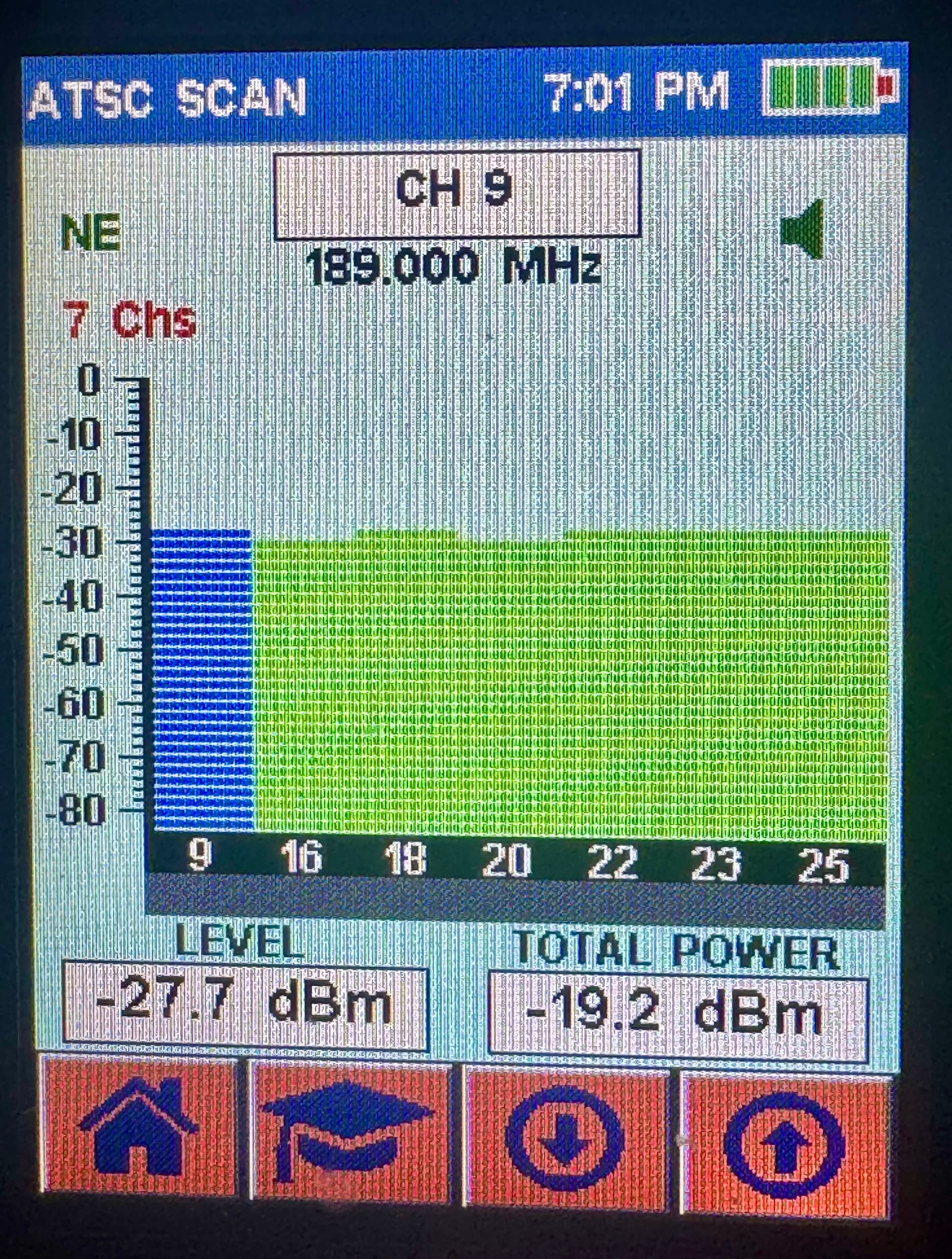
The Tablo feed comes from a 2-way splitter upstream of this, so it sees -23dBm at its input as I mentioned.
The reason the Tablo scan results in less channels when its internal amp is on and there is an upstream amp or even base signal of any strength is that the internal amp is overdriven and introducing distortion. This prevents the tuners from decoding some/all of the RF channels. The reason the scan results in more channels with its amp off in this scenario is a lower level but “cleaner” signal is hitting its tuners.
That doesn’t mean the antenna and downstream amp/coax/fitting setup is delivering every available RF transmitter at levels and (importantly) adequate SNR for the Tablo tuners to decode reliably. It just means the “hottest” parts of the RF signal aren’t overdriving the Tablo internal amp.
Thanks for reminding me about internal AGC, which the Tablo does not have. This triggered my memory about this whole topic from the past.
1 Like
Location location location…
I also use an antenna splitter. But mine is near the terminus by the TV. Less than 2ft of coax to the Tablo and 2ft to the TV.
My antenna doesn’t have an amp. So I use the Tablo amp with no problem.
Based on what others have posted, you could consider an attenuator or RF filter on the Tablo side.
Good luck!
OK. Tablo internal amp off. Check.
Direct connect gets lots more channels. Check.
2-way splitter dropping about 3.5dB plus a bit for the additional fittings. Less channels. You are “on the edge “ for signal level/quality at that point. Check the cables and splitter to be sure, but I suspect you are “on the edge” anyway. Conditions (weather, seasons, solar flares, aliens) will give you unreliable performance. Not enough “rig for the gig” as we used to say in the live music business. I think you are looking at how to get “more” into your signal gathering and distribution setup. More level and better SNR so you have margin, and can feed more devices like the TV directly without things being unreliable.
1 Like
Just for a little more completeness on this topic … the real challenge in this OTA TV game is signal to noise ratio or SNR. ATSC 1.0 tuners can handle a very wide range of signal level as I already mentioned. However, SNR is more critical to achieving reliable decoding by the tuners.
If you like numbers, steady SNR above 30dB is widely considered excellent and reliable. SNR between about 25-30dB can still produce excellent results, but is a bit more susceptible to problems when environmental conditions are less than perfect. SNR between 20-25dB is useable, but now things are getting even more dicey. SNR below 20dB is generally not useable.
I fight this in my area because here in Utah we have very hilly and mountainous terrain. All OTA TV originates in Salt Lake City, and is then rebroadcast by so-called translators, which are simply hundreds of low power transmitters on local high points all over the state. Sort of like connect the dots.
My best shot at OTA TV is an antenna farm about 5 miles due east with low power transmitters and one hill between, so no line of sight. This results in multipath interference that kills SNR and is very hard to overcome. In short, more antenna higher up is the only way to improve things.
My available SNR looks like this …
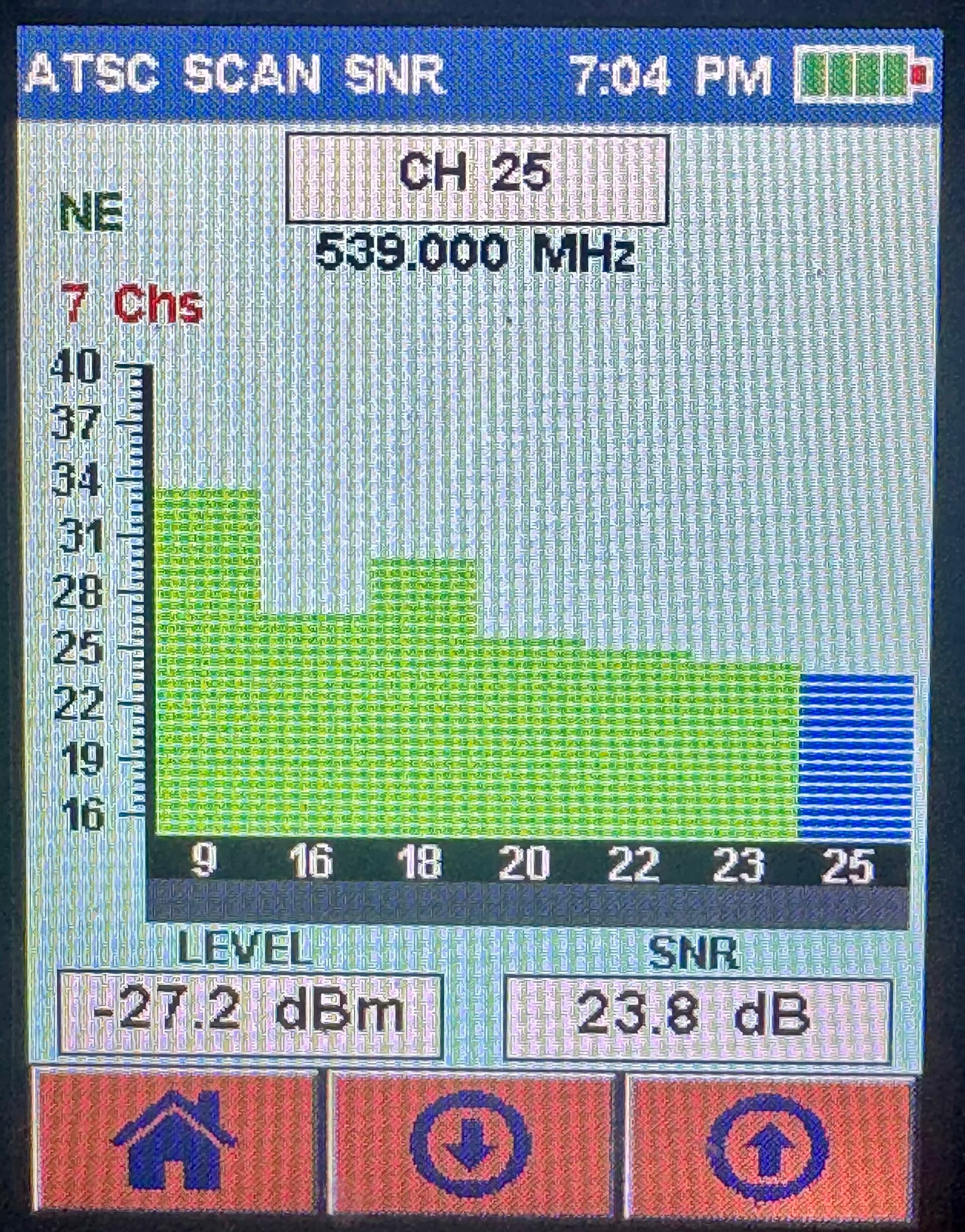
Turns out the higher the frequency, the more multipath kills SNR. It’s easy to see that in this chart from my signal meter. The highest RF channel transmitter also has the lowest SNR. In this case, it is the transmitter that carries CW. No surprise this is the first one I have trouble with when environmental conditions deteriorate.
I know this is another long winded post. Sorry. But maybe it helps to understand more about what is actually going on.