The antenna you are using is considered a “small” antenna. While it is a good antenna it is not sufficient for your distance from the broadcast towers. That is why you are employing signal boosters.
For the distance you are located you need a much bigger antenna to capture more signal and possible not need boosters which also boost bad stuff that causes reception issues.
At a bare minimum you need a good larger mid range antenna or bigger to eliminate the need for boosting the signal.
Check out Antenna man for recommendations for mid range or bigger antennas. A different antenna will fix your issues. You may not want to hear that but that is what you need to do.
I am 30 miles from the broadcast towers in NYC and I use a much bigger outdoor antenna and NO boosters! I tried smaller antennas and had issues and had to use boosters.
This one is outstanding. I have it, and have helped a couple of neighbors install these on their homes. Significantly outperforms others that I tried previously. Antenna Man likes it, as well.
You would be better off with 1 highly directional antenna and an antenna rotator, or 2 highly directional antennas and a proper antenna combiner. Of course, budget and install logistics are always considerations.
A pair of these …
and one of these …
would be ideal, but also a significant investment.
That’s quite an investment! I’ll wait and see how the current configuration works out. My antenna is omni-directional, because the stations are in 2 opposite directions, north and south.
Did I read correctly that, in your original post, you mentioned that you’re using the antenna indoors? Perhaps moving it outside up 15’-20’ high, maybe above your roof, would be sufficient to improve your signal.
Regarding the “signal quality” reading on some of these low-cost meters - my thought is that if you’re just spinning the antenna on a horizontal axis around a point to “dial in” the best signal, then such a meter can help you determine where the signal is the best along that axis.
A meter may not be necessary with the omni-directional antenna. But if you go with one of the long-range Televes or other brand antennas, it might be useful.
In the “old days” my dad could get a couple of fuzzy channels with a coathanger.
I certainly don’t advocate spending more than you need to make it all work. I just presented a “high-end” solution that may very well be required in “difficult” circumstances. There are even larger, more expensive solutions (like stand-alone towers) that I know a few hard-core cord cutters have pursued to get decent signals in very rural areas.
The most important thing is you find a solution that “fits” your specific area. Unfortunately, while many may be located in urban areas with lots of signal all around (the “rabbit ears” locations), many others are forced to get deeper in the pool to really make this “free” OTA thing work well. It has nothing to do with the Tablo.
Pixelation is only on a few channels. One station is closer, and I record off the farther station. On another, I record off the nearer station. Not consistent.
Inconsistent behavior is almost always a sign of signal quality issues. RF signal quality is affected by all sorts of transient factors. Weather (heat, cold, clouds, wind), reflections from buildings/hills, the multitude of other RF signals crowding the airwaves, even solar activity.
If your signal is “on the edge” so to speak, what you experience in real life is a channel that’s perfect at some point in time, and then crappy or even gone at another. The episode of a show you recorded last week was perfect. This week’s episode is a mess, or perhaps even “failed to record”.
The “better” your RF signal quality is base case, the more resilient it is against these transient effects. You essentially need “more antenna” to survive less than optimum conditions and have more reliable performance more of the time.
I see the current ClearStream antennas are a bit different now. Does your antenna have the reflector on the back of it? Looks like the wire used for those typical metal dog kennels/cages.
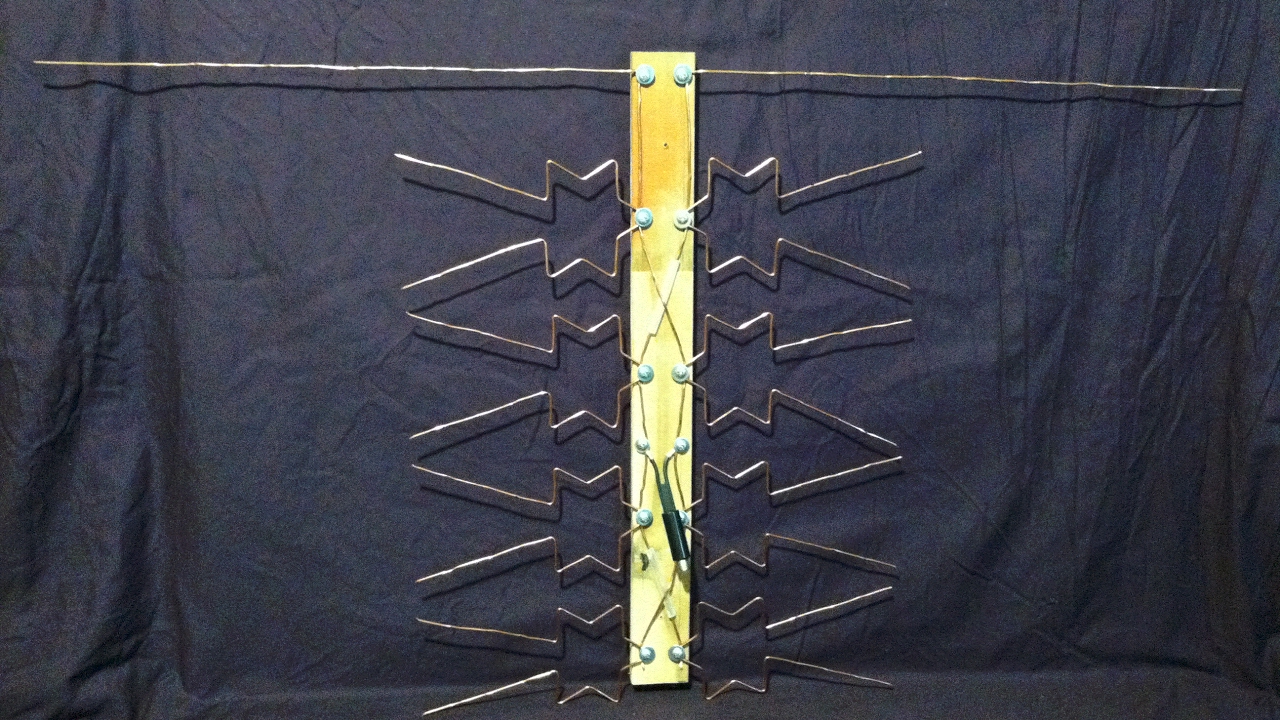
When I first got into OTA broadcasts, I contemplated making my own antenna. There are some pretty interesting DIY antenna builders out there. This one has both UHF and HighVHF elements.
Some DIY makers used chicken wire or the 1/4" hardware cloth fencing as the reflector backing. Some didn’t use anything.
There was a group of us who had an extensive thread on the gen 4 pixelation problem. 3 of us are in the same area having pixelation problems with the same channels. We are at distances of 8, 16 and 50 miles from the antenna farm. Reading thru the thread will give you an idea of the gyrations we went thru. Is it Tablo? Is it Roku? Is it the Firestick?
I finally concluded that the problem is the result of a screw up by the FCC. They assigned adjacent transmitter frequencies to 2 channels instead of separating them with a channel between them. Start reading from post 18 or 19 in the thread to get the final discoveries that led to the conclusion that the FCC screwed up. There’s nothing that Tablo can do about it.
Just say’n, fundamentally - an antenna is an antenna. There’s nothing special about an “HD” antenna over an “old day” pre-HD antenna. Not necessarily a coat hanger.
But yes, many modern antenna are “tuned” and designed for specific reception.
I’m using the same antenna from the NTSC days, when an HD antenna (if it was) meant heavy duty antenna. I get channels from over 45miles (line of sight) with no issues. It’s still split with one 50’ run to the other end of the house. Split again to a TV and tablo. The shorter 15’ is split between 2 TV.
There is NO quality lost just because you add splitters if you have the right set-up and a decent quality signal.
Chans 68.x are my only problem since I aimed my antenna 30 degrees off axis. 68.x comes and goes. 11 and 21 are rock solid and 11 is the one that caused the problems in the first place.
It depends on your definition of “NO quality lost”. Splitters, as well as fittings and coax, all reduce signal level. The more of these bits, the more the loss. While these passive elements don’t necessarily introduce extra “noise”, by reducing the signal level they can also reduce signal to noise ratio.
If there is enough signal level and s/n ratio to spare (so to speak), then these reductions will not affect the quality of what you see on your TV. Your tuner will still fully decode the ATSC 1.0 digital information. Perhaps this is what you mean by “the right setup and a decent quality signal” and therefore “NO quality lost”.
However, if your signal level and associated s/n ratio is borderline, introducing these losses can reduce the signal level and associated s/n ratio such that your tuner may not be able to fully decode the data (or maybe not at all). So, the “right setup” may require compensation (better antenna, signal amp, etc) for these losses.
As far as I am aware the Clearstream 2V is a multidirectional antenna (up to 180 degrees) not an omnidirectional. It is designed to be pointed at the source of the signal not away from it. The grid behind the main antenna element is there to reflect signal back to the main element. This would interfere with any signal coming from behind the antenna.
Yes, it reduces the signal. I do not have 100% signal, yet have 100% quality. Or so shows on my TVs. Some channels have a stronger than others. Maybe 75% for one 80% signal strength for another. Yet my channel quality is 100%.
You do not need to have a perfect signal to have a one-hundred percent quality signal - picture perfect.
Often this is the pinnacle of it all. There is no one-size-fits-all here. Location from towers, type of antenna and extremely important, antenna location. If you don’t get these in place - no amp or booster is going to really help too much.