I guess you’re just lucky @zippy. Maybe your devices are engineered with the same 13 y.o. tech? Perhaps the problem is everyone else, who upgrades and puts separation between their old and new tech.
Good guess but that doesn’t explain why my 2014 gen 1 and 4200 roku still work fine.
It’s all the same tech generation.
I just checked the log. I have been home watching college football this afternoon. This is data from a 1080i live OTA stream from the Tablo. Just for gags.
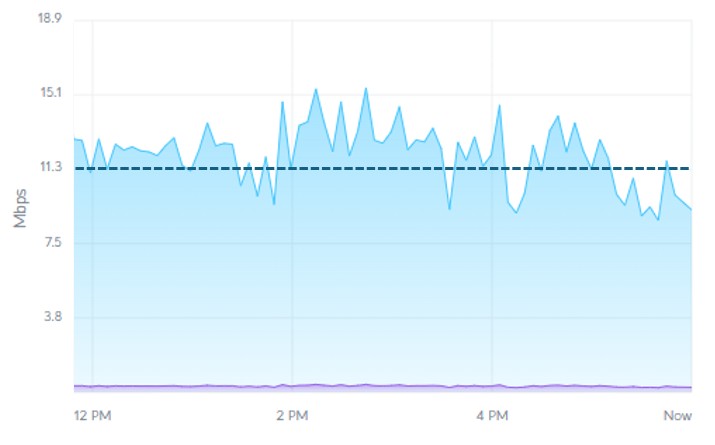
Looks like peak is around 15mbps. Most of it is below that.
The technical data for the CBS transmitter in my area says the variable video bit rate is 7.1-16.15mbps, plus 384kbps for 5.1 audio. (Rabbitears.info)
1 Like
Thanks for the post. What device produced the log and is it eth or wifi?
I think there is often confusion between max bandwidth under good conditions, and reliable continuous bandwidth under real world conditions. Streaming video requires the latter.
Wifi is notorious for being “fast” one moment, and “dead” another. Consider what happens when your WiFi device roams from one band to another. That’s a direct interruption to a data stream. If you are downloading a file, your device just waits for the data stream to start back up where it left off. Your program on a Tablo, on the other hand, craps out with an error message.
There are many other things that can affect WiFi connections. In my experience, while it’s possible to get very reliable WiFi connections, it’s easier to get very reliable ethernet connections. Either way, reliable (meaning continuous and uninterrupted) connections result in better video streaming experience. Even older tech WiFi has enough bandwidth under the right conditions.
1 Like
There’s a downside to Gb ethernet and WiFi 6/7 (noise and range). Fast ethernet and WiFi 5 appear to be the sweet spot for home A/V right now.
The only downside I’ve seen is cost as my network and Tablo work well (better) since surveying it and updating it with the newer spec devices and cables. I’m approaching the published device limit on my mesh router and I have most of the important wifi devices (computers, phones, and streamers) on 5gHz and IoT wifi devices (20 total) on 2.4gHz, while NAS, cameras, and Tablos are wired. I understand distance can be a factor, but in our case it’s not.
Of course this is from an AI search:
There is typically no downside to using Gigabit Ethernet and Wi-Fi 6 over older standards like Fast Ethernet and Wi-Fi 5; in fact, they offer substantial advantages in speed, efficiency, and network capacity. The primary “disadvantages” are usually minor considerations, such as:
- Cost: Newer equipment (routers, switches, network adapters) generally costs more than older, legacy hardware.
- Compatibility (Rare): Extremely old devices may not support the absolute newest standards, but they are designed to be backward compatible and function using the older standards.
- Power Consumption (Negligible): Newer, faster networking components might theoretically use marginally more power when operating at full capacity, but this difference is generally negligible and often offset by power-saving features.
Key Advantages
The benefits overwhelmingly outweigh these minor points:
Feature
| Fast Ethernet & Wi-Fi 5 (802.11ac) | Gigabit Ethernet & Wi-Fi 6 (802.11ax) | |
|---|---|---|
| Wired Speed | Max 100 Mbps | Max 1000 Mbps (1 Gbps) |
| Wireless Speed | Max theoretical 3.5 Gbps (aggregate) | Max theoretical 9.6 Gbps (aggregate) |
| Efficiency | Less efficient in dense environments | More efficient with multiple devices (OFDMA technology) |
| Latency | Higher | Lower, more responsive |
Upgrading to a Wi-Fi 6 router and ensuring your wired connections support Gigabit speeds provides a significantly faster and more robust network, especially as the number of connected devices in homes and offices continues to grow.
Most (if not all) high end audio streamers use 100mbps Ethernet because of the noise issue with Gb Ethernet. And while the bandwidth of WiFi 6 and 7 is wider than WiFi 5, its range is known to be shorter. If you’re not limited by either of these then you’re good to go.